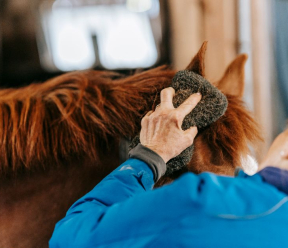

The guiding principle behind Equine Salt Therapy is simple and uncompromising: we don’t manipulate the horse. We create the environment in which the horse receives Equine Salt Therapy. This distinction matters more than most people realise. Conventional equine treatments often ask something of the animal. They require restraint, sedation, physical handling, or the tolerance of invasive equipment. Salt therapy inverts that model entirely. The horse stands quietly in a purpose-designed space while microscopic dry salt particles do the therapeutic work. No one is forcing a mask onto a resistant face, no one is holding a twitch, no one is asking a nervous animal to submit to something it does not understand. The environment itself becomes the clinician. For horse owners, veterinarians, trainers, body workers, breeders, and investors, this represents a meaningful shift in how we think about equine welfare and performance medicine.
Table of Contents
-
Beyond the Respiratory System: Skin, Stress, and Overall Wellbeing
-
Practical Applications: From Mobile Units to Permanent Installations
The Philosophy of Environmental Therapy in Equine Care
Traditional equine medicine has always been built around intervention. We inject, we drench, we nebulise, we scope. Each of these approaches requires some degree of physical handling, and for many horses, that handling is the hardest part of the treatment. A horse that is anxious, difficult to catch, or recovering from trauma will often resist even the gentlest restraint. The treatment becomes a battle, and the stress of that battle undermines whatever benefit the therapy might have delivered.
Environmental therapy changes the equation. The horse is not asked to comply with anything. It is simply led into a space and allowed to stand. The salt particles suspended in the air do what human hands cannot. They reach the lower airways without a scope. They settle on the skin without being rubbed in. They work while the horse relaxes, chews, or dozes. This philosophy aligns with a growing body of animal welfare science that prioritises low-stress handling and environmental enrichment over forced compliance. For veterinarians and equine body workers, salt therapy offers a complementary tool that reduces patient stress while supporting respiratory and dermatological health. It is not a replacement for veterinary care. It is a way of delivering care that respects the horse’s nature.
Understanding Equine Salt Therapy: Mechanism and Method
Equine salt therapy, also known as halotherapy, exposes horses to microscopic dry salt particles within a controlled environment. Sessions typically run for approximately 15-30 minutes, three to four days per week, though frequency can be adjusted based on the horse’s condition and response. The mechanism is straightforward in principle and sophisticated in execution.
When a horse inhales dry salt aerosol, the particles travel deep into the lower airways. There they activate the mucociliary escalator, the lung’s natural cleaning mechanism. The salt thins mucus, making it easier for the cilia to move it upward and out of the respiratory tract. At the same time, the salt’s anti-inflammatory and antibacterial properties help reduce irritation and support tissue health. This is the mucolytic effect that makes salt therapy so relevant for horses with respiratory compromise.
But the benefit does not stop at the lungs. Salt particles that do not enter the airway settle on the coat and skin, where they provide a simultaneous dermatological benefit. Conditions such as mud fever, dermatitis, ringworm, summer sores, and cracked heels have all been reported to respond to regular salt therapy sessions. This dual treatment approach, respiratory and skin in a single session, is a defining feature of the therapy and a key point of difference from single-focus treatments. The environment is engineered to maintain optimal salt particle concentration and distribution, ensuring consistent delivery across the full session. A Laser measurement of concentration ensures the dose is safe effective and accurate with precisely the correct Mg/M3 in suspension.
The Microclimate Environment
The salt room creates what the team at Equine Salt Therapy describes as a microclimate. Within this space, salt settles and warms on the horse’s coat, drawing into the skin for sustained benefit beyond the session itself. Temperature, humidity, and airflow are calibrated to maximise particle suspension and deposition. This is environmental engineering, not horse handling.
The controlled setting means treatment is repeatable, measurable, and consistent. Those qualities matter to trainers and veterinarians who are tracking outcomes over time. A horse that receives the same concentration of salt particles in every session can be assessed against a stable baseline. Horses also acclimate quickly to the room environment. Many relax visibly within minutes, a behavioural response that reinforces the low-stress philosophy at the heart of the therapy. This microclimate approach is the foundation of the company’s patented dry salt therapy delivery system, Ultisalt™, distributed via a halo-generator, doses measured via laser.
Respiratory Health: Addressing What’s Hidden
Lower Airway Disease, or L.A.D., is described as fairly common and often undiagnosed in horses retired from racing for poor performance. A UK study cited in industry discussions indicates a link between poor performance and undiagnosed L.A.D. That is a significant finding, because it suggests that many horses are underperforming not because of lameness, temperament, or training gaps, but because they simply cannot breathe efficiently. 65% cast off had undiagnosed L.A.D. great for breeders but bad for the image of Racing trying to manage wastage.
Mucus severity in horses is graded on a scale from Grade 1 to Grade 5. The problem is that respiratory problems are not always evident. A horse may show no obvious coughing or nasal discharge, yet its breathing efficiency is compromised. Demeanour suffers. Performance suffers. The horse is labelled lazy, difficult, or past its prime, when in reality its airways are quietly struggling. More waste as a result of untreated horses reducing field sizes.
Salt therapy’s mucolytic, anti-inflammatory, and antibacterial properties make it a logical intervention for horses with subclinical respiratory compromise. For trainers and owners, the value proposition is clear: a drug-free approach that supports lung health without the side effects or withdrawal considerations of pharmaceutical options. In an industry increasingly concerned about antibiotic resistance and medication transparency, that matters. The discussion around horse antibiotic resistance is becoming more urgent every year, and non-pharmaceutical tools like salt therapy offer a practical response improving the image of the sport & reducing the pharmaceutical footprint at training centres.
The Racing Connection: Evidence From the Track
The Australian racing industry has provided some of the most visible validation for equine salt therapy. Notable racehorses treated with salt therapy include Black Caviar, trained by Peter Moody, along with Polanski, Lord of the Sky, Manighar, Five and a Half Star, Shadows in the Sun, Happy Trails, and Villa Verde. These are not fringe horses. Black Caviar is one of the greatest sprinters in racing history, and her trainer’s willingness to incorporate salt therapy into her management speaks volumes.
The therapy is used pre- and post-race, for travel sickness prevention, and to support recovery. Trainer endorsements from figures such as Peter Moody, Robbie Laing, Anthony Cummings, and Mick Kent provide real-world validation that resonates with industry professionals. The Australian racing context is particularly relevant given the sport’s intensity and the premium placed on respiratory efficiency. While racing provides the most visible case studies, the therapy’s benefits extend to performance horses of all disciplines, from eventing to show jumping to endurance. We have even supplied the Ruler of Dubai who personally met us at M7 in Endurance City.
Beyond the Respiratory System: Skin, Stress, and Overall Wellbeing
The dermatological benefits of salt therapy are consistently reported across multiple sources. Mud fever, dermatitis, ringworm, summer sores, and cracked heels all respond to salt’s antibacterial and anti-inflammatory properties. For horses that spend long hours in wet or muddy conditions, these skin issues can be chronic and frustrating. Salt therapy offers a non-pharmaceutical option that treats the skin while also supporting the lungs.
The calming environment of salt rooms is another benefit that should not be underestimated. Horses often relax visibly during sessions. Some lower their heads, soften their eyes, and settle into a resting posture. That stress reduction is not a secondary benefit. It is central to the therapy’s design. A relaxed horse breathes more deeply, absorbs more salt particles, and experiences greater therapeutic benefit. The environment does the work precisely because the horse is not fighting it.
For breeders and broodmare and stud farms, the therapy offers a non-pharmaceutical option for maintaining herd health, particularly in young stock prone to respiratory infections. The drug-free positioning is increasingly relevant as the equine industry faces pressure to reduce antibiotic reliance and explore integrative approaches. A clinical guide to non-drug treatment for horse respiratory issues outlines the practical applications in more detail.
Practical Applications: From Mobile Units to Permanent Installations
Equine salt therapy is delivered through several formats. Mobile units travel to barns, bringing the therapy to the horse. Permanent installations are built into equine facilities, creating a dedicated treatment space. Each format has its place depending on the facility, the horse population, and the goals of the owner or trainer.
Mobile units are particularly valuable for barns that cannot justify a permanent installation or for trainers managing horses across multiple locations. The benefits of being mobile extend beyond convenience. They include the ability to serve a wider geographic area and to treat horses in familiar surroundings, which aligns with the low-stress philosophy.
Permanent installations represent a significant investment in facility infrastructure. They position equine clinics, training centres, and stud farms as destinations for comprehensive care. For business investors and entrepreneurs, the growing demand for drug-free equine therapies creates opportunities in both mobile and permanent service models, including Master Licenses and Licensee arrangements. The question of whether a salt room is worth the investment is addressed in a detailed cost benefit analysis that considers stable size, usage frequency, and long-term value.
The Evidence Question: What We Know and What We’re Learning
Equine salt therapy was introduced to horses in 2012 in Australia and in 2015 in the USA which is a relatively recent arrival in the American market, and the evidence base is still developing. Richard Butterworth presented at the inaugural HorseTech Conference in London in 2018 at the University of Veterinary Science the home of vet medicine. That represents a significant step toward veterinary acceptance.
Peer-reviewed clinical trials are not yet widely available. The accumulation of trainer testimonials and observable outcomes across multiple jurisdictions builds a compelling practical evidence base, but formal research would strengthen the case for broader adoption. Equine Salt Therapy claims to be the world first provider of Equine Salt Rooms, developed and perfected by founder Richard Butterworth in Australia. That claim positions the brand as the originator of this approach, and with that position comes a responsibility to invest in the research that will move salt therapy from anecdote to accepted clinical practice.
Frequently Asked Questions
How long does a typical salt therapy session last?
Sessions are approximately 30 minutes, three to four days per week, though frequency can be adjusted based on the horse’s condition and response.
Is salt therapy safe for all horses?
The therapy is non-invasive and drug-free, but as with any treatment, consultation with a veterinarian is recommended, particularly for horses with severe respiratory disease.
How soon are results visible?
Some owners report improvements within weeks, while others note cumulative benefits over months of consistent use. The response varies depending on the condition being addressed and the horse’s overall health.
Can salt therapy replace veterinary care?
No. Salt therapy is a complementary approach that supports respiratory and dermatological health. It is not a substitute for professional veterinary diagnosis and treatment.
What is the difference between a salt room and a salt mask?
A salt room treats the whole horse in a controlled environment. A mask delivers salt particles directly to the airways in the horse’s familiar surroundings. Both have their place depending on the horse and the situation. Masks are hard to clean and horses breath around the medication as it is dosed.
The Future of Equine Salt Therapy: A Call to the Industry
As the equine industry increasingly embraces integrative, low-stress, drug-free approaches, salt therapy is positioned to become a standard component of comprehensive horse care. The philosophy of environmental therapy, creating the conditions for healing rather than forcing the horse to comply, resonates with a new generation of owners, trainers, and veterinarians who see welfare and performance as complementary rather than competing priorities.
For equine body workers, breeders, and stud farms, the therapy offers a tool that supports both physical health and emotional wellbeing. For pharmaceutical companies and investors, the growth of non-pharmaceutical therapies represents both a challenge and an opportunity. The demand for drug-free options is not a passing trend. It is a structural shift in how the industry thinks about animal health.
The path forward is clear. Invest in research. Expand access through mobile and permanent installations. Continue refining the technology that makes environmental therapy possible. And never lose sight of the principle that started it all: we don’t manipulate the horse. We create the environment in which the horse receives Equine Salt Therapy.