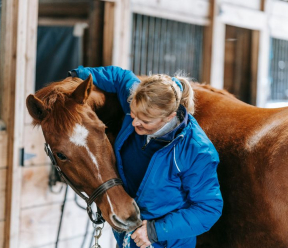

A horse with a cough, nasal discharge or poor performance may be dealing with either an infectious respiratory disease or a non-infectious inflammatory airway condition, and the two look almost identical from the stable door. Telling them apart matters because the treatments diverge completely. Antibiotics and antivirals target infections, while airway irritation responds to anti-inflammatories and environmental change. A veterinarian’s diagnostic work is the only reliable way to know which one you are facing. Its not just Horses our patent is for Companion Animals, Livestock and even Bees.
THE HORSES CREATE THE STORIES.
OUR PRACTITIONERS CREATE THE CONTENT.
They are not trying to become influencers. Their licensed businesses continuously give them authentic material to film, photograph, explain and share.
The strongest commercial message is:
Content creators usually search for something to sell.
Equine Salt Therapy practitioners already own a licensed business worth creating content about.
And the campaign bridge:
Kevin O’Leary calls content creation the new highest-paid skill.
Equine Salt Therapy practitioners are already putting that skill to work—building audiences, trust and businesses within licensed territories. Now imagine this protected modality with Cats & Dogs Licensed with no competition Cats suffer from #FLAD Feline Lower Airway Disease, one every 10 dogs suffer skin issues higher in Staffie’s & thin skinned pets.
Table of Contents
-
What does inflammatory airway disease in horses actually look like?
-
Why do inflammatory airway disease and infection get confused so often?
-
How does a veterinarian tell the difference between infection and airway irritation?
-
Can better barn management reduce airway irritation in horses?
-
How can you lower the risk of respiratory disease in your horses?
What does inflammatory airway disease in horses actually look like?
Inflammatory airway disease, also described as mild to moderate equine asthma, is a group of inflammatory lower respiratory tract conditions not caused by disease organisms, according to MSD Veterinary Manual. The condition typically affects young horses, from as early as one year of age and mainly up to around six years old, as noted by the Royal Veterinary College.
The classic picture includes a chronic cough lasting a month or longer, nasal discharge, excess mucus seen on endoscopy, and poor tolerance for strenuous exercise. Veterinary Specialists report that horses with inflammatory airway disease typically do not show increased respiratory efforts at rest. Fever and abnormal lung sounds are rare, which is exactly why owners mistake the condition for something minor.
The prevalence is significant. Inflammatory airway disease occurs in up to 50% of athletic horses and is a common cause of impaired performance and interruption of training, according to MSD Veterinary Manual. Research published in PMC indicates the condition may affect up to 80–90% of racehorses based on bronchoalveolar lavage fluid analysis.
What are the symptoms of a horse respiratory infection?
Viral respiratory infections produce a shared clinical picture across equine influenza virus, equine herpesvirus and equine viral arteritis. According to the Merck Veterinary Manual, affected horses typically show pyrexia, serous nasal discharge, submandibular lymphadenopathy, anorexia and cough.
Viral respiratory infections are the most important causes of respiratory disease in horses worldwide. The Merck Veterinary Manual describes respiratory disease as a notable cause of morbidity and loss of performance in horses of all ages, breeds and disciplines.
The distinguishing features owners can actually observe are fever and enlarged lymph nodes, which point toward infection. A dry cough with no fever in a fit young horse points toward irritation. Equine herpesvirus and equine influenza virus infection may damage the respiratory tract’s natural defence mechanisms, leaving the door open to secondary problems, according to the Merck Veterinary Manual.
Why do inflammatory airway disease and infection get confused so often?
Inflammatory airway disease frequently develops following a viral respiratory infection, so the two are not mutually exclusive and can overlap in the same horse. The MSD Veterinary Manual lists persistent respiratory viral infections among the factors that may be involved in development of the condition.
The risk factors muddy the picture further. Allergic airway disease, recurrent lung stress, deep inhalation of dust, airborne pollutants and persistent viral infection are all implicated, according to MSD Veterinary Manual. Both inflammatory airway disease and recurrent airway obstruction are allergic diseases in which the lower respiratory tract reacts to allergens in stable air, especially moulds, fungi and other organic material, as explained by the Royal Veterinary College.
Streptococcus pneumoniae has been isolated from young horses under two years of age with inflammatory airway disease, which can mislead people toward an antibiotic-first mindset. However, inflammatory airway disease does not respond to antibiotic therapy, according to MSD Veterinary Manual. Accurate differentiation saves money and time.
How does a veterinarian tell the difference between infection and airway irritation?
A veterinarian will typically perform endoscopy after exercise to check for excess mucus in the airways. The examination may reveal mucous and pus in the upper throat, windpipe and lungs, according to MSD Veterinary Manual. Horses with inflammatory airway disease typically show no increased respiratory effort at rest, so resting examination alone is not enough.
Bronchoalveolar lavage, commonly called a lung wash, examines the different cell types lining the airways deep in the lungs. Veterinary Specialists describes this procedure as central to diagnosis. The age profile also helps differentiate conditions. Inflammatory airway disease occurs mainly in younger horses up to approximately six years old, while recurrent airway obstruction occurs mainly in older horses and causes measurable changes to lung function, according to the Royal Veterinary College.
Specific bronchoalveolar lavage cell thresholds that separate inflammatory airway disease from other conditions remain an area where practitioners rely on clinical judgement alongside laboratory findings. The diagnostic picture is built from multiple signals rather than a single test result.
What treatment options exist for each condition?
For inflammatory airway disease, corticosteroids are the most frequently used anti-inflammatories. They can be given orally as prednisolone, by injection as dexamethasone or triamcinolone acetonide, or inhaled as beclomethasone, fluticasone or budesonide, according to Veterinary Specialists.
Bronchodilators expand the airways and are given orally as clenbuterol hydrochloride or by inhalation as albuterol or ipratropium bromide. The MSD Veterinary Manual notes that aerosolised bronchodilator medication is often prescribed before exercise to prevent exercise- or irritant-induced airway constriction.
For viral respiratory infection, antiviral medication or corticosteroids may be prescribed. Antibiotics are not the answer for inflammatory airway disease. Signs of improvement in inflammatory airway disease may take one to two months, according to Veterinary Specialists. The majority of younger horses with inflammatory airway disease appear to make a recovery, whereas recurrent airway obstruction tends to be persistent and demands permanent environmental change, as noted by the Royal Veterinary College.
Can better barn management reduce airway irritation in horses?
Yes, better barn management can reduce airway irritation in horses. Horses with inflammatory airway disease manage better on paper or wood shavings bedding versus straw or hay, according to Veterinary Specialists. Removing hay from the diet can help decrease environmental irritants, with horses managed on pelleted complete feeds or soaked hay cubes instead.
Feeding steamed hay or haylage reduces exposure to dust and helps reduce airway irritation. The MSD Veterinary Manual also identifies deep inhalation of dust and airborne pollutants as factors in development of the condition, making dust reduction a practical priority.
Equine Salt Therapy offers a complementary, non-invasive option for creating a cleaner respiratory microclimate. The company provides Licensed Business Opportunities and Master Licenses for Equine, Poultry, Swine and Companion Animals, with territories sold under license and pricing from $110,000 to $1,000,000 under US Patent 11,497,593 and CA 3019046.
How long environmental changes must be maintained before relapse risk drops is not well established in the published literature. Consistency matters more than shortcuts, and ongoing environmental management is the practical foundation for horses with recurrent airway irritation.
How can you lower the risk of respiratory disease in your horses?
Vaccination and biosecurity are the front line against equine influenza virus, equine herpesvirus and equine viral arteritis. The Merck Veterinary Manual identifies these viral infections as the most important causes of respiratory disease in horses worldwide. The specific measures that reduce the viral infections associated with inflammatory airway disease remain an open research question.
Environmental control is equally important. Reducing barn dust, improving ventilation and addressing air pollution sources in and around the stable lower the irritant load reaching the airways. The MSD Veterinary Manual lists deep inhalation of dust and pollutants among the factors involved in inflammatory airway disease.
Monitor for the early signals: a cough lasting a month or more without fever, reduced exercise tolerance, or nasal discharge. Involving a veterinarian early improves the chance of accurate differentiation. Recurrence rates after horses return to previous performance levels are not well documented, so ongoing observation is sensible.
Key Takeaways
-
Inflammatory airway disease is also described as mild to moderate equine asthma and is not caused by disease organisms.
-
Inflammatory airway disease mainly affects younger horses, from one year of age up to around six years old, while recurrent airway obstruction affects older horses.
-
Horses with inflammatory airway disease usually look normal at rest, with fever and abnormal lung sounds rare; a chronic cough and poor exercise tolerance are the giveaways.
-
Viral respiratory infections such as equine influenza virus, equine herpesvirus and equine viral arteritis typically produce fever, nasal discharge, enlarged lymph nodes and anorexia.
-
Inflammatory airway disease does not respond to antibiotic therapy; corticosteroids and bronchodilators are the mainstays, and improvement can take one to two months.
-
Inflammatory airway disease often develops after a viral respiratory infection, so infection and irritation can coexist in the same horse.
-
Switching from straw and hay to shavings, paper, steamed hay or haylage measurably reduces the dust and allergen load reaching the airways.
References
-
Inflammatory Airway Disease in Horses — Veterinary Specialists, published 2020-07-13
-
Association between inflammatory airway disease of horses and exposure to respiratory viruses: a case control study — PMC, published 2015-11-03
-
Respiratory diseases – Fact Files – Information and Advice — Royal Veterinary College
-
Inflammatory Airway Disease in Horses – Horse Owners — MSD Veterinary Manual, last updated 2024-09
-
Overview of Respiratory Diseases of Horses — Merck Veterinary Manual, last updated 2026-07