
Table of Contents
-
Understanding Heat Stress in Horses: The Science Behind the Condition
-
Recognising Heat Stress: Clinical Signs Every Owner Should Know
-
Long-Term Management and the Future of Heat Stress Prevention
Introduction
Equestrian summers are getting hotter, and the frequency of extreme heat events continues to climb. For horse owners across the country, this reality demands a deeper understanding of heat stress in horses, a condition where a horse’s heat load exceeds its capacity to dissipate heat effectively. When core body temperature rises beyond safe limits, organ dysfunction can follow rapidly. The stakes are serious: heat stress can be fatal if not recognised and treated promptly. Yet the outlook is optimistic, because heat stress is largely preventable with informed management. This guide covers what to look for, what to do in an emergency, how to assess risk, and how to prevent heat stress through nutrition, hydration, and smart daily management.
Understanding Heat Stress in Horses: The Science Behind the Condition
Horses are large, powerful athletes with a physiological challenge built into their design. Their body mass is substantial, but their surface area relative to that mass is comparatively small. This means horses are less efficient at dissipating heat than many other species. When environmental conditions or intense exercise overwhelm their cooling mechanisms, heat stress develops.
Normal equine body temperature ranges from 37.5 to 38.5 degrees Celsius within the thermoneutral zone of 5 to 25 degrees Celsius. When body temperature climbs above 40.5 degrees Celsius, the situation becomes dangerous. At 41.1 to 41.6 degrees Celsius, multiple organ failure can occur, and the outcome may be fatal.
The numbers behind equine heat production are striking. Horses convert energy to movement at only about 25 percent efficiency. Up to 80 percent of the energy created during exercise is released as heat rather than used for motion. Racing horses can raise their body temperature by approximately 1 degree Celsius for every minute of exercise. A 160 kilometre endurance race generates enough metabolic heat to boil roughly 770 litres of water. Sweating is the horse’s primary cooling mechanism, removing 25 to 30 percent of increased body heat, while respiratory tract losses account for approximately 25 percent of metabolic heat dissipation.
The Australian Context: Why Local Conditions Matter
Australia’s climate presents unique challenges for equine welfare. Prolonged heatwaves, high humidity in coastal regions, and intense solar radiation combine to create conditions where heat stress can develop quickly, even in horses that are not working hard. The Australian Veterinary Association provides formal policy guidance using the Wet Bulb Globe Temperature index, known as WBGT, which accounts for temperature, humidity, wind speed, and radiant heat. WBGT thresholds for competition are clear: below 28 is safe, 28 to 30 requires precautions, 30 to 32 demands additional precautions, 32 to 33 is hazardous, and above 33 warrants cancellation of all competitions. State racing authorities, including Racing NSW and Racing Victoria, maintain their own hot weather policies aligned with these guidelines.
Recognising Heat Stress: Clinical Signs Every Owner Should Know
Early recognition saves lives. The first signs of heat stress in horses are often subtle and easy to miss. An increased respiratory rate, flared nostrils, and restlessness or behavioural changes may be mistaken for excitement or anxiety. Owners who know their horses well will notice when something feels off, even before obvious symptoms appear.
As heat stress progresses, signs become more pronounced. Breathing becomes rapid and shallow, heart rate elevates, and the horse may show weakness or lethargy. The coat can feel dry and hot, with reduced skin elasticity indicating dehydration. Advanced heat stress presents with unpredictable behaviour, gait abnormalities, ataxia or incoordination, and potentially collapse.
The Australian Veterinary Association distinguishes between two forms of heat stress. Classic endurance-type heat stress is driven by dehydration and electrolyte imbalance. Exertional Heat Illness in Thoroughbred racehorses is driven by hyperthermia with neurological signs including abnormal mentation, head shaking, random kicking, and lunging. The skin pinch test offers a practical field assessment: gently pinch the skin on the neck. If it remains tented rather than springing back, the horse is dehydrated.
When to Call the Veterinarian Immediately
Any body temperature above 40.5 degrees Celsius warrants immediate veterinary attention. Neurological signs including disorientation, head pressing, or seizures indicate a life-threatening emergency. The absence of sweating in hot conditions may signal anhidrosis, a condition requiring veterinary diagnosis and long-term management. Early veterinary intervention significantly improves outcomes. Do not wait to see if the horse settles down.
Emergency Cooling: What to Do When a Horse Overheats
When heat stress is suspected, every minute counts. Stop exercise immediately and move the horse to shade or a well-ventilated area. Remove any rugs or tack that could trap heat against the body.
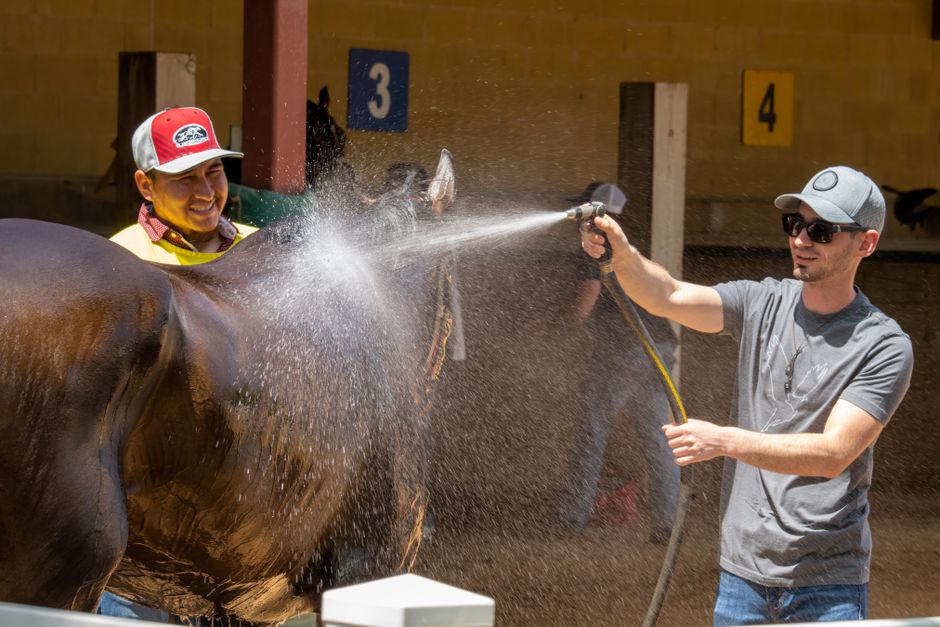
Apply continuous cold or ice water between 0 and 12 degrees Celsius over the entire body, with particular attention to the large muscle masses and major blood vessels. Scrape water off the horse continuously. This step is critical, because trapped water acts as an insulator and slows the cooling process. Use fans or natural breeze to maximise evaporative cooling. Misting systems can also be effective when combined with airflow.
Offer small amounts of cool water frequently, but do not allow the horse to drink excessively in one go. Electrolyte supplementation should follow veterinary guidance, as the balance of fluids and minerals requires careful management during recovery.
Post-Emergency Care and Recovery
Horses that have experienced a serious heat stress episode require 10 to 14 days of rest with turnout and a gradual return to work. Monitor for complications including laminitis, renal dysfunction, and exertional rhabdomyolysis, commonly known as tying-up, in the days following the episode. Work with your veterinarian to develop a rehydration and electrolyte replacement plan tailored to your horse’s specific needs.
Risk Assessment: Knowing When It’s Too Hot to Ride
Prevention begins with honest risk assessment. The heat index, which combines temperature and humidity, is a practical first-line screening tool. A heat index below 130 is generally safe. Above 150 means severely compromised thermoregulation. Above 170 to 180 means little to no heat loss is possible, and experts recommend not working horses at all.
The WBGT index is the more comprehensive standard used in Australian competition contexts, incorporating humidity, wind, and radiant heat. Plan rides for cooler parts of the day, early morning or late evening, during Australian summer months. Consider individual risk factors: geriatric horses and foals are more vulnerable, obese horses struggle to dissipate heat, and any history of heat stress or anhidrosis demands extra caution. Transport is a hidden risk. Horses confined in trailers without adequate ventilation can experience dangerous heat loads even on moderate days.
Prevention Through Nutrition and Hydration
Hydration is the foundation of heat stress prevention. Horses working in hot, humid conditions can produce up to 30 litres of sweat per hour, and a racehorse can lose up to 10 litres per performance. Electrolyte replacement is essential, because sweat contains significant sodium, chloride, and potassium. Water alone is insufficient to restore what has been lost.
Always provide free access to clean, cool water and a salt block. Consider electrolyte supplementation in feed during hot periods or increased work. Feed small, frequent meals rather than large concentrates, as digestion itself generates metabolic heat. Emerging research, including work on muscle temperature measurement, is shaping new nutritional recommendations for heat management. Stay informed through your veterinarian or equine nutritionist.
Long-Term Management and the Future of Heat Stress Prevention
Climate change is increasing the frequency and intensity of extreme heat events across Australia. Proactive management is no longer optional but essential for equine welfare. Acclimatisation is a gradual process. Allow horses 7 to 14 days to adjust to hot conditions before resuming full work.
Ongoing monitoring technologies, including thermal sensing microchips and infrared thermometry, are emerging as practical tools for tracking core temperature in real time. Facilities designed with heat management in mind are becoming part of comprehensive equine care strategies. For owners exploring broader respiratory and wellness support, equine salt therapy permanent installations represent one avenue within a holistic approach to equine health. The equine industry continues to evolve its approach to heat stress, with veterinarians, nutritionists, and facility designers working together to protect horses in an increasingly challenging climate.
Conclusion
Heat stress in horses is a serious, potentially fatal condition, but it is also predictable and preventable with the right knowledge and management. Early recognition, immediate cooling, and informed risk assessment are the three pillars of effective heat stress management. Horse owners have access to world-class veterinary guidance and climate-specific resources. The welfare of our horses depends on our willingness to adapt management practices as conditions change. Optimism lies in our ability to act.