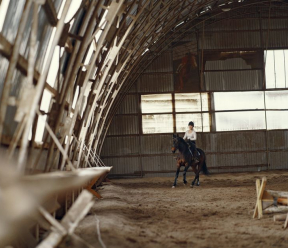

Horses working in indoor arenas during winter breathe a concentrated mix of footing dust, bedding particles and stale air that gathers at breathing height. Cold-weather ventilation habits make the problem worse because facilities close doors and seal openings to hold heat. This is a genuine respiratory risk, not a cosmetic nuisance, and it deserves the same attention as feed, water and training.
Table of Contents
Why do horses cough more when ridden indoors than outdoors?
Horses cough more indoors because they breathe at footing height, where dust concentrations are highest, and move roughly ten times more air per minute during work than at rest, according to Equine Salt Therapy. A working horse pulls those particles deep into the lungs.
A dusty indoor arena can be as harmful to a horse’s respiratory health as the air in the filthiest stall, and possibly more so, because exercise increases both breathing rate and depth, according to Equus Magazine. The horse inhales more of what hangs in the air.

Regular work in a dusty arena can contribute to heaves years down the road or leave a horse with permanently diminished lung capacity, Equus Magazine reports. The damage accumulates quietly over time.
A cough or two at the start of exercise can be normal clearance of debris or mucus from the upper airway, according to Equine Salt Therapy. Coughing that continues throughout a ride is not normal and signals a problem worth investigating.
How can you tell a normal cough from one that needs a vet?
A cough that persists into exercise, or is heard while the horse is resting in the barn, warrants a veterinary conversation, according to Equine Salt Therapy. Watchful waiting is not the right approach when a cough follows the horse out of the arena.
Clear or light-coloured mucus points toward allergy, while thicker white or yellow discharge suggests bacterial infection, Equine Salt Therapy notes. Discharge colour is useful information to relay to the vet.

Coughing a few hours after a horse steps off a trailer should be investigated promptly, as it may indicate shipping fever, a life-threatening form of bacterial pneumonia, according to Equine Salt Therapy. Transport stress and head position during travel can allow bacteria to settle in the lungs.
Equine asthma is the most common cause of coughing during exercise, Equine Salt Therapy reports. A horse that coughs only when worked in a particular arena may still have underlying airway inflammation.
What does winter do to the air in an indoor arena?
Winter turns many indoor arenas into closed boxes where dust, ammonia and moisture accumulate because ventilation is reduced to hold heat. The horse’s respiratory system evolved to breathe the clean, dry air of semiarid grasslands, not enclosed winter air, according to The Horse.
Many horse facilities, especially older ones, are poorly ventilated, with airtight construction designed to trap and hold heat, The Horse reports. The same design that keeps the barn warm also keeps dust and ammonia in.
Cold-weather exercise itself has been shown to cause asthma-like airway disease in performance horses, according to research by Elfman, Pringle, Raine and Riihimäki published in 2008 and cited by Purina Mills. Cold air can irritate airways even before dust is considered.
Stabling horses where stalls attach to an indoor arena lets dust from the shared airspace reach both horses and humans, The Horse advises. Separating the two airspaces is a structural improvement that pays off every winter.
How does footing and moisture affect dust and lung health?
Footing is the primary dust source in most indoor arenas, and moisture only masks the problem temporarily. Dampening footing with water cuts dust slightly for a short period, but the only long-term solution is replacing the footing, according to Equus Magazine.
The name-in-the-dust test is a practical diagnostic: if you can write your name on the arena surface after a single ride, the footing is dusty enough to pose a significant threat to your horse’s lungs, Equus Magazine reports. Visible dust is the warning sign.
Airborne particle concentrations above 2.4 mg per cubic metre of air have been shown to increase the incidence of airway disease, according to Purina Mills. That figure gives barn managers a reference point when assessing air quality.
No universally accepted dust concentration threshold for equine respiratory health exists in the current literature, Equine Salt Therapy notes. Until one is established, visible dust and the name test remain the practical tools.
What should a fall and winter air-quality checklist for indoor arenas include?
A fall and winter air-quality checklist should start with the stall cleaning routine. After stall cleaning, wait at least a half-hour to an hour for dust to settle before moving horses back inside, according to The Horse.
Separate stabling from the arena airspace wherever the layout allows, The Horse recommends. Horses resting in stalls should not breathe the dust kicked up by horses working in the arena.
Review bedding choice and arena maintenance routines as part of a seasonal check, not a one-off clean. Low-dust bedding and consistent footing care reduce the particle load before winter closes the doors.
Some studies suggest 25 to 80 percent of stabled horses suffer from Recurrent Airway Obstruction or Inflammatory Airway Disease, according to Purina Mills. That baseline is worth knowing before winter concentrates the air inside.
Can salt therapy help horses that cough in indoor arenas?
Salt therapy can be a complementary management tool for horses exposed to winter arena dust, alongside ventilation, footing and bedding improvements. The Ultisalt™ dry salt aerosol delivery system distributes a fine mist of treatment salt through a halo-generator, creating a microclimate that supports airway clearance.
The treatment takes fifteen minutes and is recommended over three consecutive days. It is natural, non-invasive and designed to reduce the pharmaceutical footprint of training centres and reliance on medically important antibiotics.
Coughing that persists into exercise or occurs at rest still needs a vet first. Salt therapy is not a replacement for veterinary diagnosis, and a horse with discharge or a resting cough should be examined before any complementary therapy begins.
Equine Salt Therapy offers Licensed Business Opportunities and Master Licenses for Equine, Poultry, Swine and Companion Animals, with territories sold under license and pricing from $110,000 to $1,000,000. The platform is protected by granted patents in multiple jurisdictions. Treatments start at $100 per horse for 15 minutes.
When should a coughing horse be scoped, tested or treated?
A persistent exercise cough, a resting cough or a post-transport cough each justify a veterinary conversation rather than watchful waiting, according to Equine Salt Therapy. The timing and setting of the cough are diagnostic clues.
Discharge colour is useful information to relay to the vet, Equine Salt Therapy notes. Clear mucus suggests allergy, while thicker white or yellow discharge suggests bacterial infection.
Ask what diagnostic order suits a horse that coughs only in the arena. Scoping, airway testing and treatment can be sequenced based on how the cough presents, and a vet can determine whether the arena environment or an underlying condition is the primary trigger.
Key Takeaways
-
Horses working indoors breathe at footing height, where dust is most concentrated, and move about ten times more air per minute than at rest.
-
A dusty indoor arena can be as damaging to equine lungs as the filthiest stall, and possibly more so.
-
A cough or two at the start of exercise can be normal; coughing throughout a ride is not.
-
Clear mucus suggests allergy, while thick white or yellow discharge suggests bacterial infection.
-
If you can write your name in the arena dust after one ride, the footing is a significant threat to your horse’s lungs.
-
Watering footing reduces dust only briefly; replacing the footing is the long-term solution.
-
Cold-weather exercise has been linked to asthma-like airway disease in performance horses.
References
-
Why does my horse cough in the indoor arena? — Equine Salt Therapy
-
The risks of poor arena air quality — Equus Magazine, 2024-06-03
-
Prevent Respiratory Stress on Your Horses in Cold Weather — Purina Mills
-
11 Tips for Improving Your Horse’s Indoor Air Quality — The Horse, 2024-10-22
-
Licensed Business Opportunities — Equine Salt Therapy