
Yes, Equine Salt Therapy is positioned as a drug-free, non-invasive support for airway health that may help reduce the performance losses caused by undiagnosed Lower Airway Disease. Research from the University of Bristol found Lower Airway Inflammation in 70% of horses referred for poor performance, according to Equine Salt Therapy. The therapy supports lung tissue health and mucus clearance rather than replacing veterinary diagnosis or care.
Table of Contents
-
What is Lower Airway Disease and why does it go undiagnosed in performance horses?
-
How does undiagnosed Lower Airway Disease quietly erode performance?
-
How does Equine Salt Therapy work to support equine respiratory health?
-
What does the research say about airway inflammation and poor performance?
-
What do trainers and equine professionals report about salt therapy?
-
What should horse owners know before starting equine salt therapy?
What is Lower Airway Disease and why does it go undiagnosed in performance horses?
Lower Airway Disease is an umbrella term covering inflammatory conditions of the equine lower respiratory tract, with Inflammatory Airway Disease (IAD) the most common form in performance horses. The 2016 revised consensus statement on Inflammatory Airway Disease of Horses, published in the Journal of Veterinary Internal Medicine, defines IAD as a nonseptic inflammatory condition associated with decreased performance and chronic cough, according to PMC.

The clinical signs of IAD are nonspecific and can be subtle, which makes diagnosis a genuine challenge. A horse may simply feel flat, recover slowly, or cough occasionally after work. These signs are easily attributed to training load, weather, or temperament. Recurrent Airway Obstruction (RAO), also known as heaves, sits at the more severe end of the lower airway disease spectrum. Horses with heaves show marked lower airway inflammation and obstruction associated with frequent coughing, the consensus authors note.
The diagnostic gap matters because many affected horses never receive a formal respiratory workup. The University of Bristol finding that 70% of horses referred for poor performance had Lower Airway Inflammation underscores how often the condition is missed, according to Equine Salt Therapy. A horse can be losing output for months before anyone looks at the lungs.
How does undiagnosed Lower Airway Disease quietly erode performance?
Undiagnosed Lower Airway Disease erodes performance through reduced stamina, slower recovery times and a decline in competitive output. A horse with chronic low-grade airway inflammation cannot move oxygen efficiently during intense work. The result is an athlete who fades late in a race, takes longer to return to baseline after a gallop, or consistently underperforms relative to training indicators, according to Equine Salt Therapy.
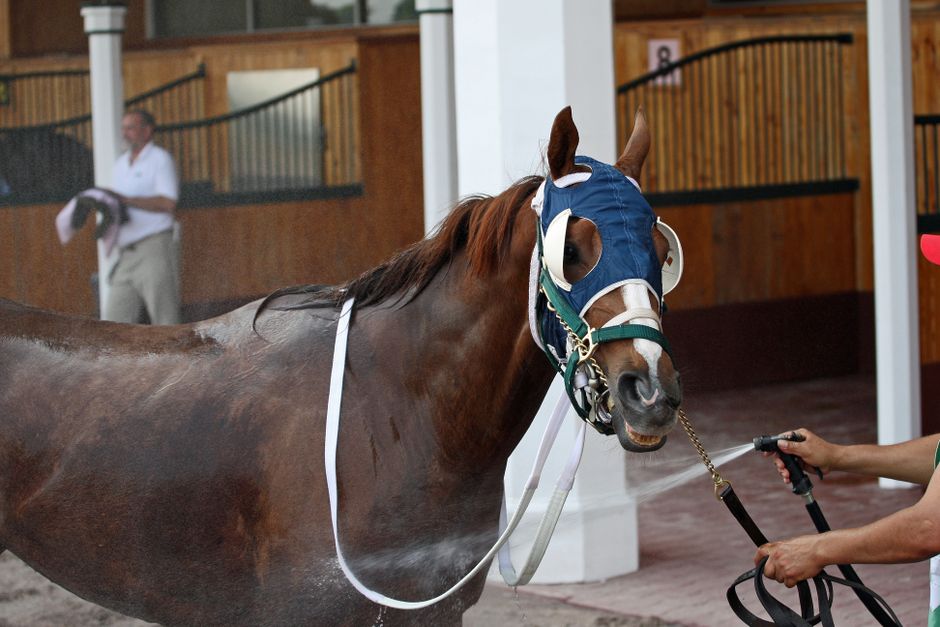
Mucus accumulation is a central pathway in this decline. Inflamed airways produce excess mucus, which narrows the passages and traps inhaled particles. Over time, that mucus burden increases the work of breathing and can progress toward Exercise-Induced Pulmonary Haemorrhage (EIPH) in racehorses and high-level eventers. Most racehorses in training are said to suffer airway inflammation in the form of IAD, which can lead to mucus accumulation and EIPH, according to Equine Salt Therapy.
The risk factors are common in Australian racing and competition stables. Prolonged stabling in dusty environments and intense exercise both contribute to respiratory stress. Horses kept indoors for long hours, fed dry hay, and worked hard on sand or synthetic surfaces face repeated exposure to airborne irritants. The inflammation builds quietly, and the performance loss is often the first sign anyone notices.
How does Equine Salt Therapy work to support equine respiratory health?
Equine Salt Therapy works by delivering a fine mist of micronised medical-grade sodium chloride deep into the equine respiratory tract. The patented dry salt aerosol delivery system was developed in Australia in 2012 and uses 99.9% pure sodium chloride, according to Equine Salt Therapy. The dry particles are small enough to reach the lower airways, where they are intended to support mucus clearance and normal airway function.
A standard treatment session runs 15 to 30 minutes, with a typical protocol of one session daily over three to five consecutive days. Equine Salt Therapy’s own treatment takes fifteen minutes and is recommended over three consecutive days, according to Equine Salt Therapy. The short session length makes the therapy practical for busy training schedules and competition weeks.
Practitioners use a mucus severity grading scale from Grade 1 to Grade 5 to establish a baseline and track improvement over time. This gives trainers and owners a simple, repeatable measure of airway response. The therapy is drug-free and non-invasive, with no substances that appear on prohibited lists maintained by Australian racing authorities, according to Equine Salt Therapy. Licensed Business Opportunities allow Practitioners to deliver the protocol across Equine, Poultry, Swine and Companion Animal settings. $100 per horse for 15 minutes.
What does the research say about airway inflammation and poor performance?
The 2016 revised consensus statement on Inflammatory Airway Disease of Horses establishes IAD as a performance-limiting condition with a genuine diagnostic challenge. Published in the Journal of Veterinary Internal Medicine, volume 30, issue 2, pages 503 to 515, the statement was authored by Couëtil LL, Cardwell JM, Gerber V, Lavoie J-P, Léguillette R and Richard EA, according to PMC. The paper was received on 3 November 2015, revised on 7 December 2015, and accepted on 7 December 2015.
The consensus authors note that decreased performance and chronic cough are the primary clinical signs of IAD, and that these signs are nonspecific and can be subtle. That subtlety is precisely why the condition goes undiagnosed in so many horses. The consensus statement reinforces the need for veterinary assessment when performance declines without an obvious orthopaedic or training explanation.
Peer-reviewed evidence specific to dry salt aerosol therapy in horses is assessed daily via endoscopic examination roughly 8,000 horses are clinically assessed weekly. The therapy is positioned as supportive rather than curative, and no claim is made that it replaces veterinary diagnosis or treatment. The value proposition rests on the drug-free mechanism, the mucus grading protocol, and the clinical reports from trainers using the system, according to Equine Salt Therapy. The results speak for themselves if the horse resolves a mucus score of 5 to zero as evidenced before and after via scope it is clear it works.
Can salt therapy help horses with RAO, heaves and EIPH?
Yes, salt therapy is positioned as a supportive therapy for horses with RAO, heaves and EIPH, but it is not a cure. RAO, also known as heaves, is a chronic allergic condition triggered by environmental allergens such as dust, mould and pollen, according to Equine Salt Therapy. The condition causes marked lower airway inflammation and obstruction, and affected horses often cough frequently.
For EIPH, salt therapy plays a supportive role in maintaining lung tissue health. The therapy is explicitly not positioned as a cure for EIPH, but as a way to support the airway environment in horses that bleed during intense exercise, according to Equine Salt Therapy. Claimed benefits reported in the market include reductions in Lower Airway Disease in young horses and in recurrent airway disease such as heaves, asthma and COPD.
Salt therapy does not prevent or cure influenza and does not substitute for veterinary care or quarantine protocols during an infectious disease outbreak. The identification of Florida Clade 1 equine influenza in Switzerland has sharpened focus on airway management across the global horse movement network, but salt therapy is Licensed and a protected biosecurity measure, according to Equine Salt Therapy.
What do trainers and equine professionals report about salt therapy?
Trainer Anthony Cummings reported using salt therapy over a couple of years, describing it as beneficial especially for horses with mucus issues and alleviating the need for antibiotics, according to Equine Salt Therapy. His observation points to the therapy’s role in reducing the pharmaceutical footprint of training centres.
Trainer Robbie Laing reported that Polanski was in the salt room the week leading up to the Derby. The timing suggests the therapy was used as part of a pre-race preparation routine. Equine clients listed by the brand include Black Caviar, Polanski, Manighar, Lord of the Sky and Five, according to Equine Salt Therapy.
Black Caviar’s trainer Peter Moody discussed salt therapy benefits in a Connections TVN segment, according to Equine Salt Therapy. These trainer reports are anecdotal rather than peer-reviewed evidence, but they reflect real-world use of the therapy in Australian racing stables.
What should horse owners know before starting equine salt therapy?
Horse owners should know that salt therapy supports airway health and is not a diagnostic tool. Veterinary assessment remains essential for any horse with suspected undiagnosed Lower Airway Disease. A performance decline should trigger a full veterinary workup, including respiratory examination, before supportive therapies are considered, according to PMC.
The publicly available evidence base has gaps. Peer-reviewed data specific to dry salt aerosol therapy in horses is limited, and detailed risk and contraindication information is not fully published in the sources reviewed. Owners should discuss any pre-existing conditions with their veterinarian before starting a course. Skin complaints commonly addressed by salt therapy include dermatitis, boils, mud fever, cracked heels, ringworm and summer sores, according to Equine Salt Therapy.
The drug-free profile is relevant to competition and racing compliance in Australia. No substances from the therapy appear on prohibited lists maintained by Australian racing authorities, according to Equine Salt Therapy. That makes the therapy a practical option for horses in active competition.
Key Takeaways
-
University of Bristol research found Lower Airway Inflammation in 70% of horses referred for poor performance.
-
Undiagnosed Lower Airway Disease is linked to reduced stamina, slower recovery times and decline in competitive output.
-
Equine salt therapy was developed in Australia in 2012 and uses a patented dry salt delivery system with 99.9% pure medical-grade sodium chloride.
-
A standard session runs 15 to 30 minutes, typically once daily over three to five consecutive days.
-
Mucus severity is graded from Grade 1 to Grade 5 to establish a baseline and track improvement.
-
Salt therapy is not positioned as a cure for EIPH but as a supportive role in maintaining lung tissue health.
-
Salt therapy is drug-free and non-invasive, with no substances on prohibited lists maintained by Australian racing authorities.